Auto Restoration Training at a Glance
Auto School Guide helps prospective students compare schools offering auto restoration training. These programs may combine automotive mechanics, electrical diagnosis, sheet-metal repair, welding, fabrication, bodywork, refinishing, upholstery, and project documentation to prepare students for work involving classic and collector vehicles. Auto restoration is not tracked as a separate federal occupation, so related automotive and body-repair data should be treated only as broader career context.
What Is Auto Restoration Training?
Auto restoration training teaches students how to evaluate and rebuild older vehicles while balancing mechanical function, structural condition, appearance, historical accuracy, safety, and the owner's intended use. A restoration may range from repairing selected systems to a complete body-off or frame-up project.
Unlike routine repair, restoration often requires students to work with worn, corroded, damaged, modified, incomplete, or obsolete components. Replacement parts may not be readily available, so technicians may need to research specifications, document assemblies, repair original parts, fabricate replacements, and verify how components fit together.
Restoration programs vary considerably. Some emphasize mechanical rebuilding, while others devote more time to sheet metal, fabrication, bodywork, paint, interiors, or custom finishing. Students should compare the actual curriculum rather than assuming every program teaches the complete restoration process.
What Do Auto Restoration Programs Teach?
Vehicle Evaluation and Planning
Students may learn to assess vehicle condition, identify missing or modified parts, recognize corrosion and structural concerns, define project goals, estimate the scope of work, and organize a restoration sequence.
Disassembly and Documentation
Training may include photographing assemblies, labeling hardware, creating parts inventories, recording measurements, protecting reusable components, and organizing parts for later reassembly.
Engine and Drivetrain Restoration
Programs may cover inspection and rebuilding concepts involving engines, fuel delivery, ignition, cooling, lubrication, clutches, transmissions, driveshafts, differentials, and related systems.
Chassis, Steering, and Suspension
Students may work with frames, unibody structures, steering components, springs, shocks, bushings, wheel bearings, brakes, alignment, and chassis measurements.
Sheet-Metal Repair and Fabrication
Instruction may include corrosion removal, patch-panel fabrication, cutting, forming, shrinking, stretching, welding, panel alignment, gap adjustment, and metal finishing.
Bodywork and Refinishing
Programs may address surface preparation, filler application, sanding, priming, corrosion protection, paint systems, color matching, polishing, and finish correction.
Electrical Systems
Students may study charging, starting, ignition, lighting, switches, gauges, wiring diagrams, circuit testing, harness repair, and safe electrical upgrades.
Interior and Trim
Depending on the program, training may include upholstery concepts, carpet, headliners, weather seals, glass, hardware, instruments, dashboards, and interior trim installation.
Research and Authenticity
Students may learn to consult service manuals, parts books, build records, photographs, factory specifications, owner documentation, and other references when determining how a vehicle was originally configured.
Reassembly and Quality Control
Training may cover test fitting, torque procedures, fluid installation, system checks, adjustment, alignment, documentation, road testing, and final inspection.
How Is a Classic Vehicle Restored?
The process depends on the vehicle's condition and the project goals, but it may include:
- Initial inspection and project definition
- Historical and technical research
- Photography, labeling, and documentation
- Careful disassembly
- Cleaning and parts assessment
- Rust and structural repair
- Chassis, suspension, steering, and brake work
- Engine and drivetrain rebuilding
- Electrical-system repair
- Body alignment and panel fitting
- Surface preparation and refinishing
- Interior and trim work
- Reassembly
- Fluid, electrical, and mechanical checks
- Alignment, testing, adjustment, and final documentation
Restoration is rarely a perfectly linear process. Parts availability, hidden corrosion, earlier repairs, incomplete documentation, and changes made by previous owners may require the restoration plan to be revised as work progresses.
Good training should emphasize careful documentation and inspection before irreversible work is performed. Removing too much original material, discarding rare parts, or beginning paintwork before panel fit and mechanical planning are complete can create costly problems later.
Original, Restored, Restomod, or Custom?
Preservation
Preservation prioritizes stabilizing and maintaining as much existing material and historical character as practical.
Factory-Style Restoration
A factory-style restoration attempts to return the vehicle toward its original appearance, materials, specifications, and configuration.
Restomod
A restomod combines classic appearance with selected modern components or upgrades, which may involve brakes, steering, suspension, drivetrain, electrical systems, comfort, or safety.
Custom Build
A custom project intentionally changes the vehicle's design, construction, stance, powertrain, interior, or finish according to a new creative direction.
These approaches have different goals. A technically successful restomod may not be considered historically accurate, while a preservation project may intentionally retain age-related finishes or materials. Students should learn to define the project standard before parts are removed or modified.
How Is Auto Restoration Different From Collision Repair?
Collision repair generally focuses on diagnosing and repairing accident damage so a vehicle can be returned to an appropriate condition using current repair procedures. Auto restoration often involves older vehicles, corrosion, obsolete components, previous modifications, incomplete records, and project goals extending beyond accident repair.
The fields share skills such as welding, panel repair, measuring, refinishing, corrosion protection, and safe shop practices. Restoration may require more historical research, fabrication, parts sourcing, repair of original components, and long-term project planning.
Mechanical Systems in a Restoration Project
A vehicle that looks complete may still require extensive mechanical evaluation. Restoration technicians may inspect engines, transmissions, steering, suspension, brakes, fuel systems, cooling systems, and electrical components before deciding whether each part should be cleaned, adjusted, repaired, rebuilt, replaced, or upgraded.
Students should learn to measure components and compare findings with reliable specifications. Reusing a component based only on appearance can result in poor performance or failure, while replacing serviceable original material unnecessarily may conflict with the project's preservation goals.
Skills discussed in restoration mechanical training may include:
- Compression and leak testing
- Clearance measurement
- Cooling-system inspection
- Fuel-system cleaning
- Ignition diagnosis
- Brake hydraulic service
- Bearing and seal inspection
- Steering and suspension inspection
- Drivetrain alignment
- Safe startup procedures
- Documenting replaced and retained parts
Sheet Metal, Rust Repair, and Fabrication
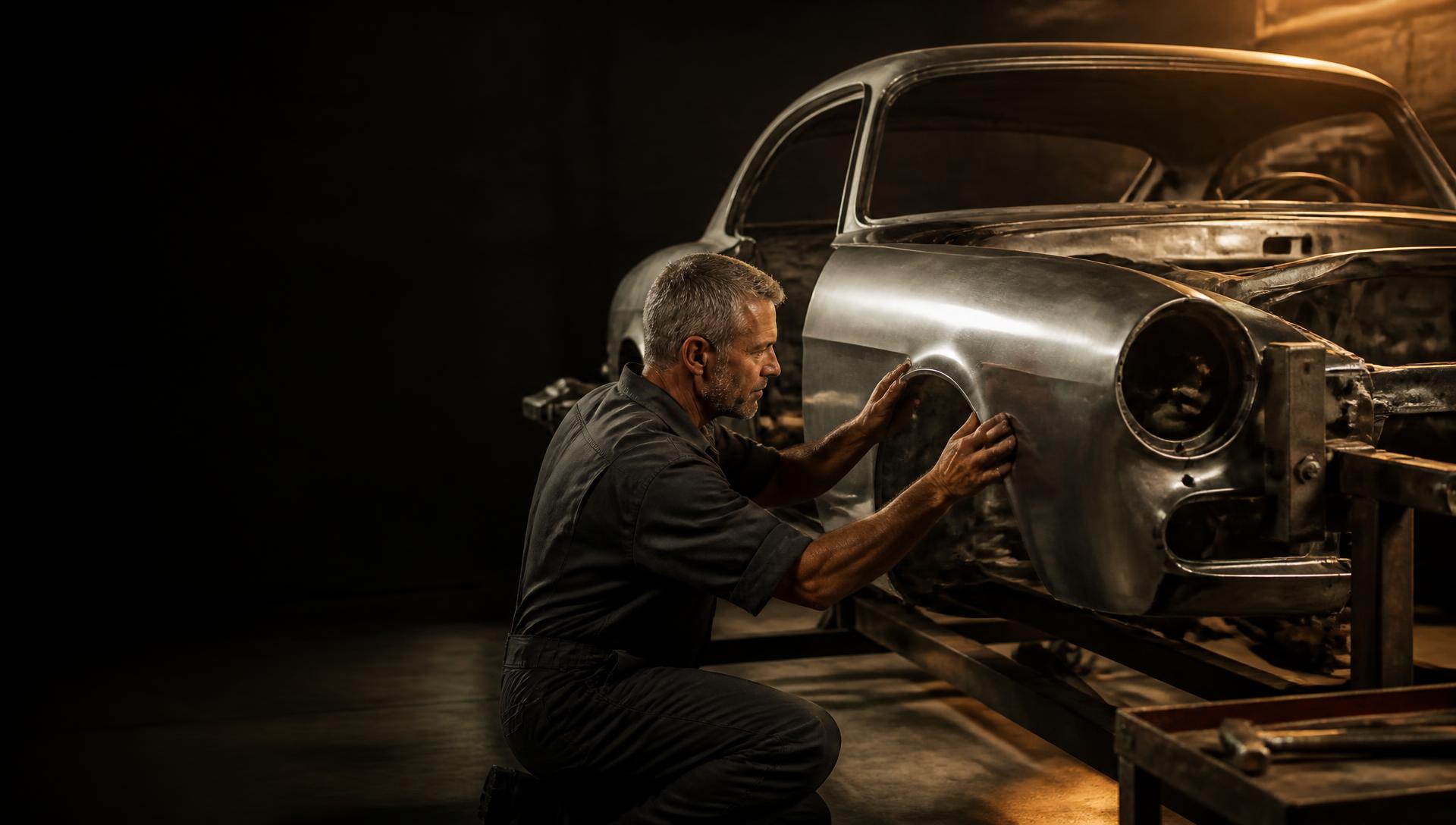
Corrosion repair is one of the defining challenges of vehicle restoration. Visible rust may represent only a portion of the damage, and corrosion can extend into seams, reinforcements, mounting points, floor structures, rocker panels, frames, and enclosed cavities.
Training may include removing damaged metal, creating templates, shaping replacement panels, controlling heat during welding, maintaining body dimensions, aligning panels, finishing welds, and protecting repaired surfaces from future corrosion.
Safe structural repair requires understanding:
- Vehicle construction
- Load paths
- Attachment methods
- Material condition
- Panel fit
- Measurements
- Welding procedures
- Corrosion protection
Concealing rust cosmetically is not restoration. Corrosion that affects structure should be repaired properly rather than covered.
Refinishing and Restoration-Shop Safety
Restoration work can involve solvents, coatings, fillers, adhesives, dust, welding fumes, compressed gases, flammable liquids, noise, lifting equipment, and rotating or powered tools. Automotive spray products may contain hazardous chemicals, including isocyanates in some coatings.
Programs should teach:
- Hazard communication
- Appropriate personal protective equipment
- Respiratory-protection requirements
- Ventilation
- Spray-booth procedures
- Safe mixing and handling
- Fire prevention
- Welding and grinding safety
- Dust control
- Safe vehicle lifting
- Hazardous-material storage and disposal
Respiratory protection must be selected and used according to the applicable hazards, regulations, product information, and the employer's written safety program. General advice is not a substitute for a workplace respiratory-protection program.
Careers Related to Auto Restoration
Training may support entry-level work such as:
- Restoration-shop technician
- Classic-car mechanic
- Restoration disassembly or assembly technician
- Sheet-metal fabrication assistant
- Body and metal technician
- Refinishing assistant
- Chassis or suspension technician
- Engine-shop assistant
- Electrical restoration technician
- Upholstery or trim assistant
- Performance and specialty-vehicle technician
- Automotive service technician
- Automotive body repairer
- Parts researcher or restoration-parts specialist
Many restoration professionals develop a specialty over time. One technician may focus on engines, another on metal shaping, another on paint, and another on electrical systems or final assembly. Smaller shops may expect technicians to perform a wider range of tasks.
Entry into high-end restoration work often depends on demonstrated craftsmanship, accuracy, problem-solving, portfolio quality, and experience—not only completion of a training program.
Career Outlook for Auto Restoration Training
The Bureau of Labor Statistics does not track auto restoration technicians separately. The closest broadly reported occupation is Automotive Service Technicians and Mechanics, which had a national median annual wage of $50,620 in May 2025. Employment is projected to grow 5 percent from 2025 through 2035, with approximately 66,200 openings projected each year on average.
Auto restoration may also involve skills associated with Automotive Body and Related Repairers. BLS reported a national median annual wage of $54,890 for that occupation in May 2025. These figures represent broader automotive occupations and are not specific wage estimates for restoration specialists.
Restoration earnings may vary according to specialty, experience, employer, geographic market, project quality, productivity, reputation, and whether a technician works as an employee, independent contractor, or business owner.
Is a Restoration Certificate the Same as Professional Certification?
No. A certificate, diploma, or degree awarded by a school documents completion of an educational program. Professional certifications—such as applicable ASE credentials—have separate testing and experience requirements.
ASE does not offer one comprehensive certification specifically titled “Auto Restoration Technician.” However, certification areas involving engine repair, suspension and steering, brakes, electrical systems, engine performance, and collision repair may relate to skills used in restoration work.
Who Should Consider Auto Restoration Training?
Auto restoration training may be a good fit for students who enjoy classic vehicles, detailed mechanical work, research, fabrication, craftsmanship, problem-solving, and long-term projects. Successful restoration work often requires patience and the willingness to repeat fitting, measuring, adjusting, and finishing tasks until components work together correctly.
Important qualities include:
- Mechanical aptitude
- Attention to detail
- Patience
- Organization
- Manual dexterity
- Accurate measurement
- Visual judgment
- Problem-solving
- Documentation habits
- Respect for original materials
- Willingness to follow safety procedures
- Ability to balance quality with project time and budget
How to Compare Auto Restoration Schools
- Is restoration a complete program, specialization, or short elective?
- How much instruction is specific to classic and collector vehicles?
- Does the program cover mechanical and body restoration?
- Are students taught disassembly and project documentation?
- Does training include sheet-metal shaping and rust repair?
- What welding processes are included?
- Does the program teach paint preparation and refinishing?
- Are electrical diagnosis and wiring included?
- Are engines or drivetrains inspected or rebuilt?
- Does the curriculum cover interiors, trim, glass, or weather sealing?
- What types of vehicles and projects do students work on?
- How much individual hands-on time is available?
- Can students build a documented portfolio?
- Are shop materials, tools, safety equipment, and paint supplies included?
- What qualifications and restoration experience do instructors have?
- Are internships or employer introductions available?
- Are completion and placement figures current and verifiable?
- What is the total program cost?
- What is the cancellation and refund policy?
Ask to see completed student work and documentation of what each student actually performed. A display vehicle may represent the work of multiple classes, instructors, outside specialists, or previous students.