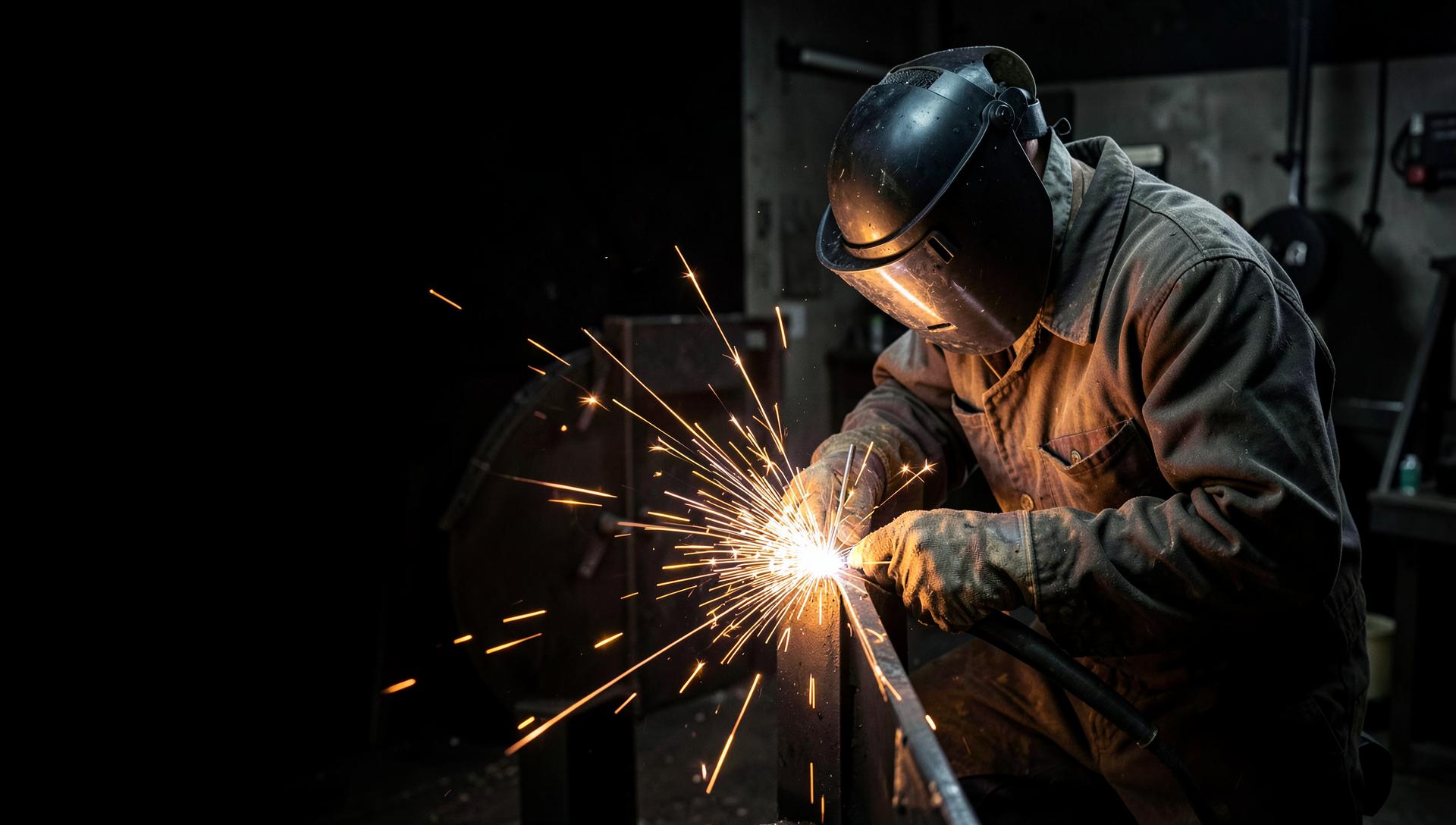
What Is Welding Technology?
Welding technology is the study of joining metals, usually by applying heat and often filler metal, so that the joint carries load as intended. It also covers cutting, fitting, and inspecting the finished work.
Good welding is repeatable rather than lucky. Programs teach the settings, technique, joint preparation, and metallurgy that make a sound weld reproducible across positions and materials.
BLS describes welders, cutters, solderers, and brazers as workers who use hand-held or remotely controlled equipment to join, repair, or cut metal parts and products.
MIG Welding
Gas metal arc welding, commonly called MIG, feeds a solid wire electrode continuously while shielding gas protects the weld pool. It is productive, relatively easy to learn, and widely used in fabrication and manufacturing.
- Wire feed speed, voltage, and their relationship
- Shielding gas selection and flow
- Short circuit, globular, and spray transfer
- Gun angle, travel speed, and stick-out
- Common defects: cold lap, porosity, and burn-through
- Aluminum welding with spool guns or push-pull systems
- Machine setup and consumable maintenance
TIG Welding
Gas tungsten arc welding, commonly called TIG, uses a non-consumable tungsten electrode with separately added filler. It is slower than MIG but offers precise control and clean results on thin material and exotic alloys.
- Tungsten selection, grinding, and contamination
- DC and AC applications, including aluminum
- Amperage control, foot pedals, and pulse settings
- Torch angle, filler feeding, and puddle control
- Shielding gas coverage and purging
- Stainless steel, aluminum, and specialty alloys
- Cleanliness and joint preparation requirements
Stick Welding
Shielded metal arc welding, commonly called stick, uses a consumable coated electrode. It tolerates wind, dirt, and rust better than gas-shielded processes, which keeps it common in construction, pipe, structural, and repair work.
- Electrode classifications and selection
- Polarity, amperage, and arc length
- Electrode storage and low-hydrogen handling
- Travel angle, weave patterns, and restarts
- Slag removal and interpass cleaning
- Out-of-position welding
- Common defects: undercut, slag inclusion, and porosity
Flux-Cored Arc Welding
Flux-cored arc welding uses a tubular wire filled with flux. Self-shielded versions work outdoors without gas, while gas-shielded versions produce high deposition rates on heavy plate.
- Self-shielded versus gas-shielded wires
- Wire classifications and applications
- Deposition rates and heavy-plate welding
- Slag coverage and removal
- Fume generation and ventilation needs
- Field welding and structural applications
Cutting and Metal Preparation
Most weld quality is decided before the arc is struck. Cutting, cleaning, and fit-up determine whether the joint can be welded correctly at all.
- Oxy-fuel cutting, heating, and torch setup
- Plasma arc cutting
- Air carbon arc gouging
- Mechanical cutting: saws, shears, and abrasive wheels
- Grinding, beveling, and edge preparation
- Cleaning mill scale, rust, paint, and oil
- Fit-up, gap control, and tacking
- Clamping, fixturing, and positioners
Blueprints and Welding Symbols
Welders work from drawings that specify not just where to weld but what kind of weld, how large, on which side, and to what standard.
- Views, sections, and dimensioning
- Reference line, arrow side, and other side
- Fillet, groove, plug, and slot weld symbols
- Weld size, length, and pitch notation
- Field weld, weld-all-around, and contour symbols
- Tail notations and specification references
- Bill of materials and cut lists
- Layout, measurement, and squaring
Weld Positions and Joint Types
Real work rarely happens on a comfortable flat bench, so programs train students to weld in multiple positions.
Positions
- Flat (1F and 1G)
- Horizontal (2F and 2G)
- Vertical (3F and 3G)
- Overhead (4F and 4G)
- Pipe positions such as 5G and 6G, where taught
Joint types
- Butt joints with and without groove preparation
- Lap joints
- Tee joints and fillet welds
- Corner joints
- Edge joints
- Multi-pass welds, root, fill, and cap
Metallurgy and Distortion Control
Heat changes metal. Understanding what happens in and around the weld explains cracking, warping, and unexpected failures.
- Carbon and alloy steels, stainless steels, and aluminum
- Heat-affected zone and grain structure
- Preheat and interpass temperature
- Post-weld heat treatment concepts
- Hydrogen cracking and low-hydrogen practice
- Residual stress and distortion
- Sequencing, back-stepping, and fixturing to control warping
- Dissimilar metal considerations
Inspection and Quality
Programs teach students to evaluate their own work before anyone else does, using visual criteria and, where available, additional testing methods.
- Visual inspection criteria and weld gauges
- Profile, size, undercut, and reinforcement limits
- Porosity, cracks, incomplete fusion, and slag inclusion
- Bend testing and destructive testing
- Nondestructive testing awareness: dye penetrant, magnetic particle, ultrasonic, radiographic
- Welding procedure specifications and procedure qualification
- Documentation and traceability
Awareness of nondestructive testing within a welding program is not the same as training as an NDT technician, which follows a separate pathway.
Welding Safety
Welding involves arc radiation, fume, heat, compressed gases, electricity, and fire risk. OSHA maintains requirements and guidance for welding, cutting, and brazing.
- Eye and face protection and correct shade selection
- Arc flash burns and protecting nearby workers with screens
- Fume exposure, ventilation, and respiratory protection
- Flame-resistant clothing, gloves, and leathers
- Fire prevention, hot work permits, and fire watch
- Compressed gas cylinder handling and storage
- Electric shock hazards and equipment condition
- Confined space welding hazards
- Noise, grinding, and hand protection
School Certificates vs. Welder Certifications
These are two different things, and conflating them causes real confusion when job hunting.
- A school certificate, diploma, or degree documents that a student completed a course of study
- A welder qualification or certification documents that a specific welder produced an acceptable weld under a specific procedure, in a specific position, on specific material and thickness, tested to a specific standard
Welder qualification is commonly process-, position-, code-, employer-, and procedure-specific. Employers, codes, and contracts determine which qualifications a job requires, and qualifications can require periodic maintenance or requalification.
One certification does not qualify a welder for every job. Completing a program does not automatically certify a graduate. Ask each school which tests it prepares students for, whether testing is available on site, and what the test fees are.
Career Paths
Welding appears across many industries, and the day-to-day work varies widely between them.
- Production welder in manufacturing
- Fabricator and fitter in a job shop
- Structural welder in construction and steel erection
- Pipe welder in mechanical, process, and energy work
- Maintenance and repair welder in plants and facilities
- Shipyard, rail, or heavy equipment welder
- Welding inspector with additional qualification
- Welding instructor, sales, or shop supervisor with experience
Conditions range from climate-controlled shops to outdoor field work with travel, shift work, and overtime. Some specialties involve heights, confined spaces, or extended time away from home.
Career Outlook
BLS reports a median annual wage of $53,750 for welders, cutters, solderers, and brazers in May 2025, projects about 2 percent employment growth from 2025 through 2035, and projects about 40,300 openings each year on average.
National figures describe an occupation, not the outcome of any school or graduate. Local demand depends on manufacturing, construction, and energy activity in a given region.
How to Compare Welding Schools
Questions worth asking each school:
- Which processes are taught: MIG, TIG, stick, flux-cored?
- How many hours of booth time does each student get?
- How many students share each welding booth?
- Is pipe welding offered, and in which positions?
- Are aluminum and stainless steel included?
- Is blueprint reading and welding symbols a dedicated course?
- Is fabrication and layout included?
- Is cutting taught with oxy-fuel and plasma?
- Does the program prepare students for a specific welder qualification test?
- Is testing available on site, and are test fees included?
- Is inspection or NDT awareness included?
- Are consumables, metal, gear, and helmets included in the cost?
- What credential is awarded, and how long does it take?
- Are internships or employer partnerships available?
- What is the total cost, including fees?
Contact this school to verify its welding processes, booth time, materials, certification preparation, equipment, schedules, costs, and availability.