What Is Industrial Maintenance?
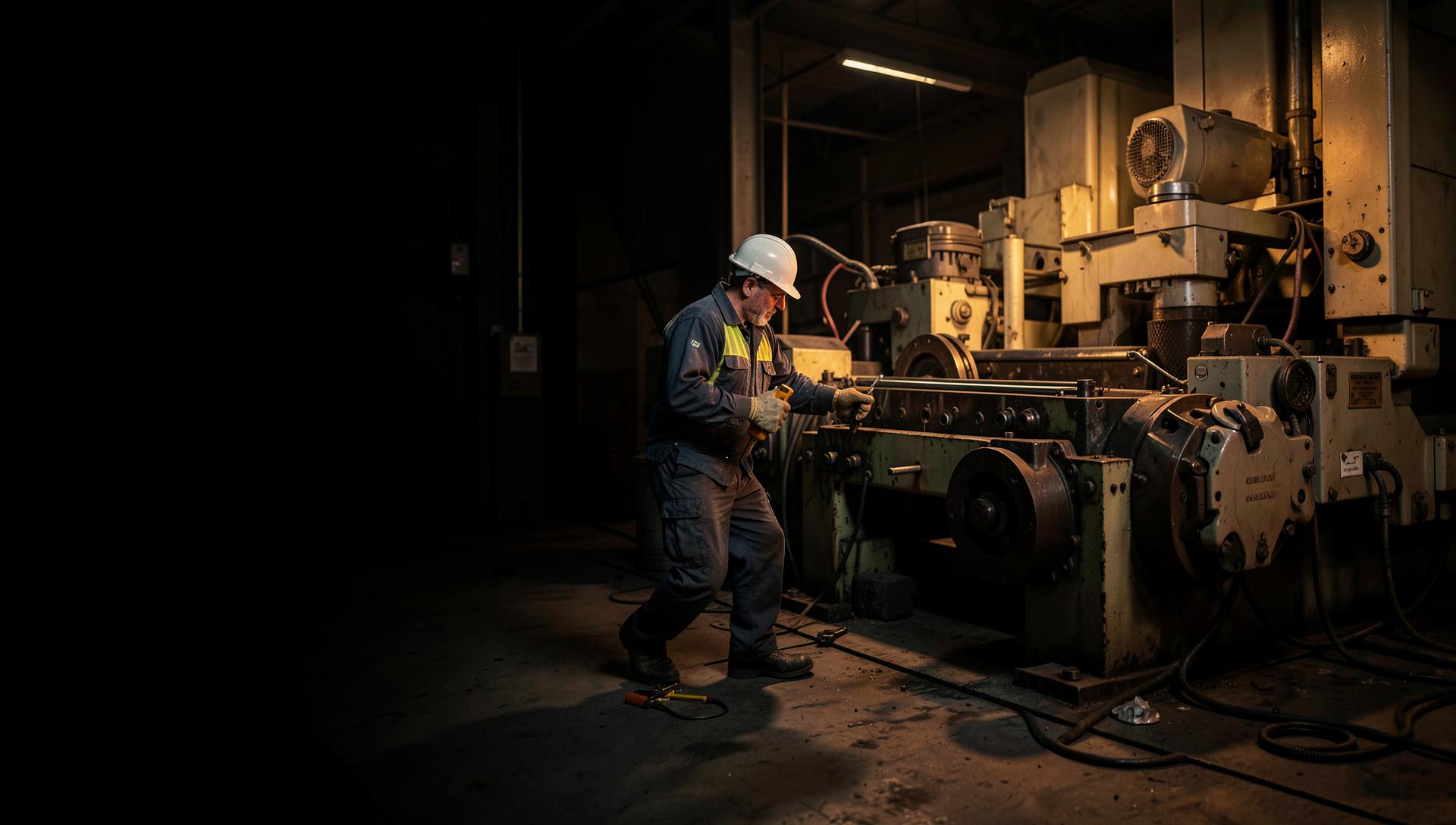
Industrial maintenance is the work of keeping production equipment running safely and reliably. Technicians inspect machinery, catch developing problems, perform scheduled service, and repair breakdowns that stop production.
The job is deliberately cross-disciplinary. A single shift can involve mechanical repair, hydraulics, electrical troubleshooting, a PLC fault, and a welded bracket. That breadth is why maintenance programs cover several trades at once.
BLS describes industrial machinery mechanics, machinery maintenance workers, and millwrights as workers who install, maintain, and repair factory equipment and other industrial machinery.
Mechanical Power Transmission
Power transmission covers how motion and torque move from a driver to a driven machine. Understanding it makes many failures predictable rather than mysterious.
- Torque, speed, and mechanical advantage
- Couplings and their alignment requirements
- Speed reducers and gearboxes
- Clutches and brakes
- Lubrication types, intervals, and contamination control
- Component removal, installation, and fits
Bearings, Shafts, Belts, Chains, and Gears
These are the components maintenance technicians replace most often, and correct installation matters more than raw strength.
- Rolling-element and plain bearings
- Bearing mounting, fits, and failure analysis
- Shafts, keys, keyways, and setscrews
- V-belts, synchronous belts, and sheave alignment
- Belt tensioning methods
- Roller chain, sprockets, and chain wear measurement
- Spur, helical, bevel, and worm gearing
- Backlash, wear patterns, and gear inspection
- Seals, gaskets, and leak prevention
Hydraulics and Pneumatics
Fluid power moves heavy loads and provides precise force control. Programs teach both circuits and the practical work of finding a fault in a live system.
Hydraulics
- Pressure, flow, and force relationships
- Pumps, motors, and cylinders
- Directional, pressure, and flow control valves
- Reservoirs, filtration, and fluid condition
- Accumulators and stored energy hazards
- Reading hydraulic schematics
- Leak, heat, and contamination troubleshooting
Pneumatics
- Compressed air generation, drying, and distribution
- FRL units, regulators, and lubricators
- Air cylinders, actuators, and grippers
- Solenoid valves and manifolds
- Speed control and cushioning
- Air leaks, moisture, and efficiency
Motors and Industrial Electrical Systems
Maintenance technicians work on electrical systems constantly, even when the visible failure is mechanical.
- Electrical fundamentals and three-phase power
- AC and DC motors and nameplate data
- Motor starters, contactors, and overloads
- Control circuits, relays, and pilot devices
- Variable frequency drives and soft starters
- Motor testing and insulation resistance
- Reading electrical prints and ladder diagrams
- Safe use of meters and test equipment
PLCs, Sensors, and Controls
Automated equipment reports much of its own condition. Technicians who can read a PLC program and check I/O status resolve faults far faster than those who cannot.
- PLC hardware, processors, and I/O
- Ladder logic reading and basic editing
- Timers, counters, and sequencing
- Discrete sensors: inductive, capacitive, photoelectric
- Analog instrumentation and signal standards
- Encoders and position feedback
- Human-machine interfaces and alarm screens
- Using program status to isolate a fault
PLC platforms differ between schools and employers. Ask which brands are used and whether students troubleshoot live equipment or only simulators.
Alignment, Measurement, and Calibration
Precision maintenance reduces repeat failures. Misalignment, soft foot, and imbalance shorten bearing and seal life long before anything breaks visibly.
- Precision measuring tools and their use
- Dial indicator and laser shaft alignment
- Soft foot detection and correction
- Belt and sheave alignment
- Leveling and machine installation
- Balancing concepts
- Torque specifications and fastener practice
- Instrument calibration and documentation
Preventive and Predictive Maintenance
Maintenance strategy determines whether a plant responds to failures or prevents them. Programs typically compare reactive, preventive, predictive, and reliability-centered approaches.
- Scheduled inspection and service routes
- Lubrication programs and route planning
- Vibration analysis fundamentals
- Infrared thermography basics
- Oil analysis and wear-particle concepts
- Ultrasonic leak and bearing detection
- Computerized maintenance management systems
- Spare parts, criticality, and inventory
- Work orders, history, and failure documentation
Troubleshooting Production Equipment
Downtime pressure rewards method over guessing. A structured approach means gathering symptoms, checking the obvious inputs, isolating systems, testing rather than assuming, repairing, and verifying under load.
- Interviewing operators for accurate symptoms
- Using machine documentation and prints
- Dividing mechanical, electrical, and control causes
- Testing safely on energized and de-energized systems
- Root-cause analysis instead of repeat repairs
- Verifying operation and documenting the fix
Welding and Fabrication Fundamentals
Many maintenance programs include enough welding and fabrication for repair work: guards, brackets, frames, and worn components.
- Cutting and metal preparation
- Basic arc welding processes such as MIG and stick
- Joint types and simple fabrication
- Layout, measurement, and fitting
- Hot work permits and fire watch practices
- Weld inspection at a maintenance level
Maintenance welding instruction is not the same as a welding technology program or a welder qualification test. Ask what welding content a program includes and what it does not.
Lockout/Tagout and Machine Safety
Maintenance work often requires being inside machinery that can move, energize, or release stored energy. OSHA addresses the control of hazardous energy and machine guarding directly.
- Energy isolation and lockout/tagout procedures
- Verification of zero energy state
- Stored energy in springs, hydraulics, pneumatics, and capacitors
- Machine guarding and interlock integrity
- Confined space awareness
- Fall protection and elevated work
- Arc flash and electrical safe work practices
- Personal protective equipment and permits
Career Paths
Several distinct roles exist in and around plant maintenance, and they are not interchangeable.
- Industrial maintenance mechanic: services and repairs production machinery
- Millwright: installs, aligns, dismantles, and moves heavy machinery, often through an apprenticeship
- Industrial or maintenance electrician: focuses on electrical systems and may require licensing depending on jurisdiction
- Controls or automation technician: specializes in PLCs, drives, and instrumentation
- Reliability technician: focuses on predictive monitoring and failure analysis
- Maintenance planner or supervisor: schedules work and manages resources
- Manufacturing or reliability engineer: an engineering role that typically requires an engineering degree
- Machine operator: runs production equipment but does not perform maintenance repairs
Employers include manufacturing plants, food and beverage processors, packaging operations, warehouses and distribution centers, utilities, refineries, and facilities departments. Shift work, on-call rotations, and planned shutdown work are common.
Career Outlook
BLS reports a median annual wage of $64,100 for the industrial machinery mechanics, machinery maintenance workers, and millwrights group in May 2025, projects 14 percent employment growth from 2025 through 2035, and projects about 51,900 openings each year on average.
These figures describe a combined occupational group at the national level, not the outcome of any particular school. Local demand depends on the manufacturing and industrial base in a given region.
How to Compare Schools
Questions to ask before enrolling:
- Which trades does the program cover, and in what depth?
- How many hands-on lab hours are included?
- What production or training equipment do students work on?
- Are hydraulics and pneumatics taught on live trainers?
- Which PLC platforms are used, and is troubleshooting included?
- Is precision alignment taught with indicators or lasers?
- Is welding included, and to what level?
- How is lockout/tagout and machine safety taught?
- What credential is awarded, and how long does it take?
- Does the program count toward an apprenticeship?
- Are internships or employer partnerships available?
- Are tools and safety equipment included?
- What is the total cost, including fees?
- Which campus offers the program, and what schedules are available?
Contact this school to verify its industrial maintenance curriculum, laboratory equipment, credentials, schedules, costs, and availability.