What Is Robotics and Automation Technology?
Robotics and automation technology is the applied field of building, installing, maintaining, and troubleshooting the automated systems that move, assemble, inspect, and package products.
The field is often called mechatronics because it deliberately combines mechanical systems, electrical power, electronics, control logic, and software. A technician who understands only one of those areas cannot diagnose a work cell that spans all of them.
BLS describes electro-mechanical and mechatronics technologists and technicians as workers who operate, test, and maintain unmanned, automated, robotic, or electromechanical equipment.
Mechanical and Electrical Fundamentals
Automation programs build a base in both mechanical and electrical fundamentals before adding control systems on top.
Mechanical
- Fasteners, tolerances, and precision measurement
- Bearings, shafts, couplings, and alignment
- Belts, chains, gears, and speed reduction
- Linear motion, guides, and ball screws
- Conveyors and material handling
- Blueprint and mechanical drawing interpretation
Electrical
- Voltage, current, resistance, and power
- AC and DC circuits and three-phase power
- Control transformers and power supplies
- Relays, contactors, and control wiring
- Electrical schematics and ladder diagrams
- Safe measurement with meters and scopes
Industrial Robots and Work Cells
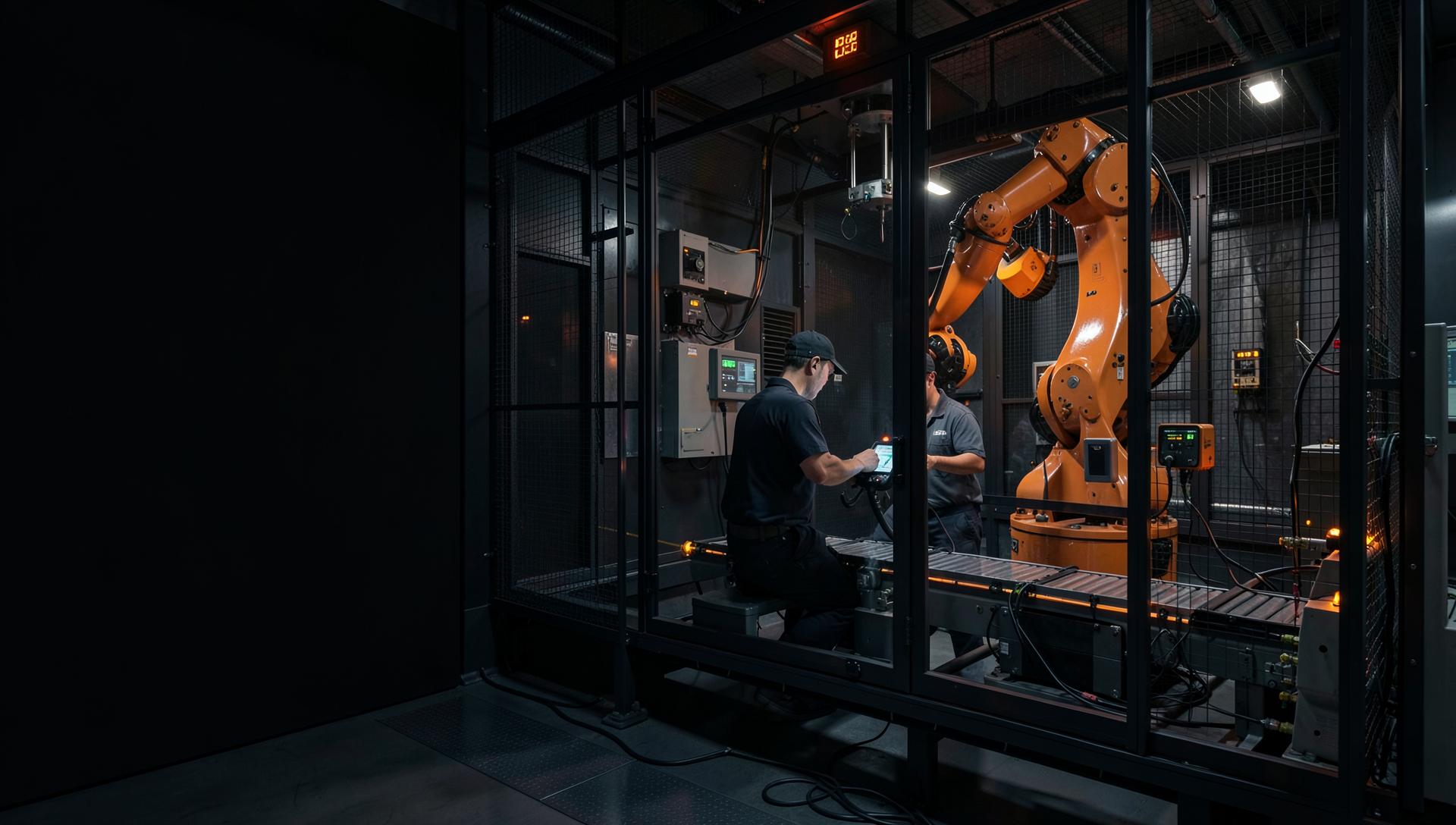
An industrial robot is only part of a work cell. The cell also includes fixturing, conveyance, sensing, guarding, controls, and often a vision system.
Robot types
- Six-axis articulated arms
- SCARA robots for fast planar assembly
- Delta robots for high-speed picking
- Cartesian and gantry systems
- Collaborative robots designed to work near people
Robot topics
- Coordinate frames: world, tool, and user frames
- Teach pendant operation and jogging
- Point teaching, paths, and motion types
- Tool center point setup and payload configuration
- End effectors: grippers, vacuum, and tooling
- Program structure, I/O, and cell handshaking
- Mastering, calibration, and homing
- Robot maintenance, backups, and battery service
PLCs and Control Logic
In most automated cells, the PLC is the supervisor. It sequences the process, coordinates the robot, monitors safety and sensors, and drives the operator interface.
- PLC hardware, processors, racks, and I/O modules
- Discrete and analog I/O wiring and addressing
- Ladder logic contacts, coils, and branching
- Timers, counters, and comparison instructions
- Sequencing, state logic, and interlocks
- Data handling and math instructions
- Going online, monitoring, and safe editing
- Program documentation and version control practices
PLC and robot brands differ between schools and employers. Ask which platforms are used and how much time students spend programming and troubleshooting real hardware rather than simulations.
Sensors and Machine Vision
Automation depends on reliable sensing. If the cell cannot detect part presence, position, or quality, the rest of the logic is guesswork.
- Inductive, capacitive, and photoelectric sensors
- Ultrasonic and laser distance sensing
- Limit switches and mechanical detection
- Encoders and position feedback
- Pressure, temperature, and flow instrumentation
- Analog signal standards and scaling
- Vision cameras, lighting, and lensing
- Inspection, measurement, and barcode reading
- Vision-guided robotics and part location
Motors, Drives, and Motion Control
Motion control turns commands into precise movement. Programs typically cover the motor types used in automated equipment and the drives that command them.
- AC induction motors and variable frequency drives
- Servo motors, drives, and feedback loops
- Stepper motors and open-loop positioning
- Tuning, acceleration profiles, and following error
- Gearboxes, actuators, and mechanical advantage
- Homing routines and limit handling
- Coordinated and multi-axis motion
Pneumatics and Hydraulics
Compressed air does much of the clamping, gripping, and short-stroke motion in automated equipment. Hydraulics appear where higher force is needed.
- Air preparation, regulators, and filtration
- Solenoid valves, manifolds, and valve banks
- Cylinders, actuators, rotary units, and grippers
- Flow controls, cushioning, and speed adjustment
- Reading pneumatic and hydraulic schematics
- Hydraulic pumps, valves, and cylinders
- Leak, contamination, and pressure troubleshooting
- Stored energy and safe release procedures
Human-Machine Interfaces
Operators interact with automation through HMI panels and displays. Technicians use those same screens to read alarms, check status, and adjust setpoints.
- HMI hardware and connectivity
- Screen navigation, tags, and data display
- Alarm configuration and history
- Recipes and setpoint management
- Diagnostics screens for maintenance
- Basic HMI editing, where taught
Industrial Networks
Controllers, drives, robots, sensors, and HMIs communicate over industrial networks. Understanding addressing and topology speeds up both commissioning and fault finding.
- Network topologies and cabling
- IP addressing and device configuration
- Common industrial protocols and device profiles
- Distributed I/O and remote racks
- Diagnosing communication faults and dropped nodes
- Data collection and production monitoring concepts
Programming and Troubleshooting
Employers hire automation technicians largely for downtime response. The valued skill is a repeatable diagnostic method rather than familiarity with one machine.
- Reading alarms and interpreting fault codes
- Using PLC program status to trace a stopped sequence
- Verifying sensor inputs and output commands
- Separating mechanical, electrical, and logic causes
- Testing safely on energized and de-energized systems
- Restoring robot programs and configuration backups
- Root-cause analysis to prevent repeat failures
- Documenting changes and repairs
Robot Safety and Lockout/Tagout
Industrial robots move quickly, with force, and along paths that are not always intuitive. OSHA provides guidance on robotics safety and on the control of hazardous energy during service.
- Guarding, fencing, and interlocked access doors
- Light curtains, safety mats, and area scanners
- Emergency stops and safety-rated controls
- Teach mode, reduced speed, and enabling devices
- Never entering an unguarded active work envelope
- Lockout/tagout and verification of zero energy
- Stored energy in pneumatics, springs, and gravity axes
- Collaborative robot risk assessment concepts
Career Paths
Technician and engineering roles in automation are distinct, with different education requirements and responsibilities.
- Automation or robotics technician: installs, maintains, and troubleshoots automated equipment
- Controls technician: focuses on PLCs, drives, and control wiring
- Mechatronics technician: works across mechanical, electrical, and control systems
- Field service technician: commissions and services equipment at customer sites
- Maintenance technician: supports automated production equipment in a plant
- Robotics engineer: designs robotic systems, typically requiring an engineering degree
- Controls or software engineer: develops control architecture and code, typically requiring a degree
A certificate or associate degree in robotics technology does not qualify a graduate as an engineer. Engineering roles generally require an engineering degree and a different scope of work.
Employers include manufacturers, automotive and food production plants, warehouses and distribution centers, packaging companies, system integrators, and equipment builders.
Career Outlook
BLS reports a median annual wage of $73,900 for electro-mechanical and mechatronics technologists and technicians in May 2025, projects about 3 percent employment growth from 2025 through 2035, and projects about 1,400 openings each year on average.
This is a relatively small occupation, so the annual openings figure is small. Graduates may also be hired under other titles, such as maintenance or controls technician, which carry their own separate data.
How to Compare Programs
Questions worth asking before enrolling:
- How many industrial robots are available, and of which brands?
- Do students program robots on a teach pendant themselves?
- Which PLC platforms and software are used?
- Is there a complete automated work cell for training?
- How much lab time is included versus lecture?
- Are servo and motion control systems taught hands-on?
- Is machine vision included?
- Are pneumatics and hydraulics taught on live trainers?
- How is robot safety and lockout/tagout taught?
- What credential is awarded, and how long does it take?
- Do credits transfer toward a degree?
- Are internships or employer partnerships available?
- What is the total cost, including tools and fees?
- Which campus offers the program, and what schedules are available?
Contact this school to verify its robotics, PLC, mechatronics, automation, equipment, programming, schedules, costs, and program availability.