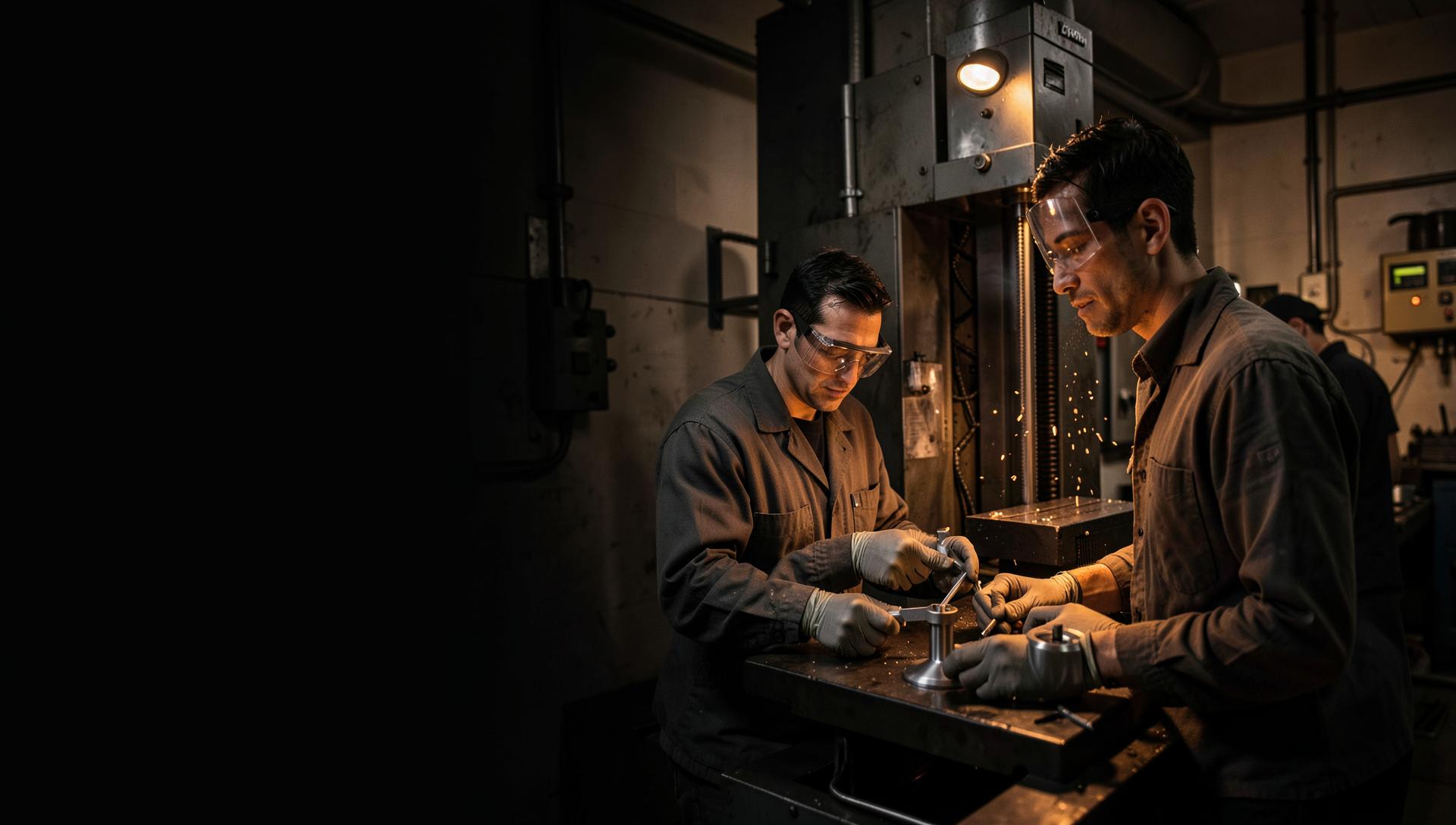
What Is CNC Machining?
Computer numerical control (CNC) machining is a manufacturing method in which a computer directs the motion of a cutting tool or workpiece to remove material and produce a finished part. The machine follows a program that defines tool positions, feed rates, spindle speeds, and tool changes.
CNC work sits between engineering and production. Someone must interpret a drawing, plan the sequence of operations, select tooling, set up the machine, prove out the program, and verify that finished parts fall inside the specified tolerances.
BLS describes machinists as workers who set up and operate machine tools to produce precision metal parts, instruments, and tools, working from blueprints, sketches, or computer-aided design files.
What Do CNC Machining Programs Teach?
Coursework varies by school, but a CNC program may include:
- Shop safety and personal protective equipment
- Shop mathematics and trigonometry for machining
- Manual milling and turning fundamentals
- Blueprint reading and drawing interpretation
- Geometric dimensioning and tolerancing
- Precision measurement and inspection
- Cutting tools, tool materials, and tool wear
- Workholding and fixturing
- Speeds, feeds, and cutting conditions
- Coordinate systems and machine axes
- Work offsets and tool offsets
- CNC setup and first-part verification
- G-code and M-code programming
- Conversational programming, where offered
- CAD modeling fundamentals
- CAM toolpath generation and post-processing
- Quality control and documentation
- Preventive maintenance of machine tools
Not every program covers every subject at the same depth. Confirm the curriculum, software versions, machine list, and hands-on hours directly with each school.
CNC Mills, Lathes, and Other Machine Tools
Most programs begin with manual machining so students understand what the cutter is doing before a control does it for them. Manual lathe and mill practice builds a feel for cutting pressure, chip formation, tool sharpness, and part rigidity.
Common machine types
- Vertical machining centers for milling, drilling, and tapping
- Horizontal machining centers for higher-volume production
- CNC turning centers and lathes for round parts
- Mill-turn and multi-axis machines, where available
- Surface and cylindrical grinders
- Saws, drill presses, and secondary equipment
Workholding and tooling
Holding the part securely and repeatably matters as much as the cutting program. Students may work with vises, chucks, collets, soft jaws, clamps, and dedicated fixtures, and learn how workholding choice affects accuracy, cycle time, and safety.
Tooling instruction typically covers end mills, drills, taps, reamers, boring bars, inserts, and holders, along with tool materials such as high-speed steel and carbide, and how coatings and geometry affect tool life.
Blueprint Reading and Geometric Dimensioning
A machinist works from a drawing or model that defines the part. Blueprint instruction covers views, sections, title blocks, revision levels, notes, surface finish callouts, and dimension types.
Geometric dimensioning and tolerancing (GD&T) adds a symbolic language for describing form, orientation, location, and runout relative to datums. Understanding GD&T tells a machinist which features are critical, how the part will be inspected, and where the available tolerance actually is.
Ask schools whether GD&T is a dedicated course or is folded into other classes, and whether students inspect their own parts against the print.
CNC Setup, Offsets, and Tooling
Setup is where programs become parts. A typical setup sequence may include:
- Reviewing the print, program, and setup sheet
- Installing and squaring workholding
- Loading and identifying tools in the carousel or turret
- Measuring and entering tool-length and diameter offsets
- Establishing the work coordinate system and part zero
- Dry running or graphing the program before cutting
- Cutting a first article at reduced feed and rapid rates
- Inspecting and adjusting offsets to hit the middle of tolerance
- Documenting the setup so it can be repeated
Coordinate systems are central to this work. Students learn machine coordinates, work coordinates such as G54 through G59, absolute and incremental positioning, and how offsets shift the tool relative to the part.
CNC Programming and G-Code
G-code is the address-based language most CNC controls read. Programs are built from blocks that command motion, spindle and coolant functions, tool changes, and cycles.
Introductory programming instruction often covers:
- Program structure, block numbering, and comments
- Rapid and feed moves
- Linear and circular interpolation
- Spindle, coolant, and tool-change commands
- Canned cycles for drilling, tapping, and boring
- Cutter compensation and tool-length compensation
- Subprograms and repetition
- Editing at the control and safe program proving
Many shops rely primarily on CAM output, but reading and editing code at the machine remains a practical skill for setup, correction, and troubleshooting.
CAD/CAM and Toolpath Development
CAD software defines part geometry. CAM software uses that geometry to generate toolpaths, then a post-processor converts the toolpath into code the specific control can run.
CAM coursework may address:
- Importing and preparing models
- Stock definition and work origin setup
- Roughing, finishing, and rest-machining strategies
- Contour, pocket, drilling, and thread operations
- Turning toolpaths for lathe work
- Tool libraries and cutting-condition data
- Simulation and collision checking
- Post-processing and program output
Software packages differ between schools and employers. Ask which CAD and CAM systems students use and how much time is spent generating and proving their own toolpaths.
Precision Measurement and Quality Control
Precision work is only precise if it can be measured. Students commonly learn to use calipers, micrometers, height gauges, indicators, gauge blocks, pins, thread gauges, and surface-finish comparators.
Quality instruction may cover:
- Reading tolerance callouts and deciding on accept or reject
- Measurement error, temperature, and technique
- Calibration and gauge care
- In-process inspection versus final inspection
- First-article and layout inspection
- Coordinate measuring machines, where available
- Documenting results and nonconformances
Machining Materials and Cutting Conditions
Material behavior drives tool selection and cutting parameters. Programs may cover aluminum, mild and alloy steels, stainless steels, tool steels, cast iron, brass, and engineering plastics, and how each affects chip formation, heat, and finish.
Students calculate surface speed, spindle RPM, feed per tooth, feed rate, and depth of cut, then adjust for rigidity, tool condition, coolant, and the finish required. Recognizing chatter, built-up edge, and premature tool wear is part of that learning.
Machine-Shop Safety
Machine shops contain rotating spindles, sharp tooling, hot chips, coolant mists, and heavy material. OSHA addresses machine guarding and the control of hazardous energy, and both topics apply directly to machining environments.
Safety instruction usually covers:
- Eye and face protection and appropriate clothing
- Machine guarding and interlocks
- Lockout/tagout awareness during service and setup
- Safe chip handling and housekeeping
- Coolant handling, skin contact, and mist
- Safe lifting and material handling
- Emergency stops and shop emergency procedures
Careers in CNC Machining
Manufacturing uses several distinct roles, and they are not interchangeable. A short program does not qualify a graduate as an engineer.
- CNC operator: loads parts, monitors cycles, performs basic checks and adjustments
- CNC setup technician: prepares machines, tooling, and offsets for production runs
- CNC programmer: develops toolpaths and programs, often in CAM
- Machinist: plans and produces precision parts across manual and CNC equipment
- Tool and die maker: builds and maintains dies, jigs, fixtures, and molds
- Quality or inspection technician: verifies parts against specifications
- Manufacturing engineer: an engineering role that typically requires an engineering degree
Machinists work in machine shops, job shops, and manufacturing plants serving aerospace, medical, automotive, energy, defense, and general industry. Shift work and overtime are common in production settings.
CNC Machinist Career Outlook
BLS reports a median annual wage of $58,750 for machinists in May 2025, projects about 1 percent change in machinist employment from 2025 through 2035, and projects about 30,400 annual openings for machinists and tool and die makers combined.
Openings are projected even where employment is flat or declining, largely because experienced workers retire or move into other occupations. Local conditions depend on the manufacturing base in a given region.
National occupational data describes an occupation, not the outcome of any particular school or graduate.
How to Compare CNC Machining Schools
Useful questions to ask each school:
- Which CNC mills, lathes, and controls do students actually run?
- How many students share each machine?
- How many hands-on laboratory hours are included?
- Is manual machining taught before CNC?
- Which CAD and CAM software is used?
- Is G-code programming taught, or only CAM output?
- Is GD&T a dedicated course?
- What measuring equipment do students use, and do they inspect their own parts?
- Is there a CMM or metrology lab?
- What credential is awarded, and how long does it take?
- Are day, evening, or part-time schedules offered?
- Are internships, co-ops, or apprenticeships available?
- Are tools, safety equipment, and materials included in the cost?
- What is the total cost, including fees?
- Which campus offers the program?
Contact this school to confirm its current CNC machining curriculum, equipment, software, schedules, costs, and program availability.