What Is Nondestructive Testing?
Nondestructive testing, commonly shortened to NDT, is the inspection of materials, components, structures, vehicles, and equipment without making them unusable. The field is also called nondestructive examination (NDE) or nondestructive inspection (NDI).
NDT specialists may use sound waves, electromagnetic fields, penetrant liquids, magnetic particles, radiographic imaging, cameras, and other technologies to find surface or internal indications that require evaluation.
O*NET describes nondestructive testing specialists as workers who test the safety of structures, vehicles, and vessels using equipment such as ultrasound, X-ray, and fiber optics. (Non-Destructive Testing Specialists)
What Do NDT Specialists Do?
NDT technicians help evaluate whether materials and components meet applicable codes, specifications, procedures, and quality requirements.
Depending on their training and authorization, their work may include:
- Inspecting welds, castings, forgings, pipes, tanks, machinery, and structural components
- Looking for cracks, corrosion, voids, inclusions, delamination, metal fatigue, and other discontinuities
- Selecting and calibrating testing equipment
- Performing inspections according to written procedures
- Interpreting signals, images, and test results
- Recording inspection settings and findings
- Preparing technical reports
- Comparing results with applicable codes, standards, and acceptance criteria
- Maintaining inspection equipment
- Supporting quality-control and preventive-maintenance programs
O*NET also identifies inspection targets such as aircraft, trains, nuclear reactors, bridges, dams, and pipelines. Some specialists use drones or remote equipment to inspect large or difficult-to-reach structures. (Non-Destructive Testing Specialists)
An indication found during testing is not automatically a rejectable defect. Technicians must follow the applicable procedure and acceptance criteria when interpreting or reporting what they find.
Nondestructive Testing Methods Students May Study
Program content varies considerably. Prospective students should confirm exactly which methods a school teaches and how much supervised laboratory practice is included.
Visual Testing
Visual testing, or VT, uses direct observation and optical tools to identify visible surface conditions. Technicians may use magnifiers, mirrors, borescopes, video scopes, cameras, and measurement tools.
Although it is the most fundamental NDT method, visual inspection still requires proper lighting, surface preparation, equipment knowledge, documentation, and familiarity with applicable acceptance criteria. (asnt.org)
Liquid Penetrant Testing
Liquid penetrant testing, or PT, uses specially formulated liquids to reveal surface-breaking discontinuities in solid, nonporous materials.
The process generally involves cleaning the surface, applying penetrant, allowing sufficient dwell time, removing excess penetrant, applying developer, and examining the resulting indications under the required lighting conditions. (asnt.org)
Magnetic Particle Testing
Magnetic particle testing, or MT, is used on ferromagnetic materials. The part is magnetized and fine magnetic particles are applied. A surface or near-surface discontinuity can disrupt the magnetic field and attract the particles, creating a visible indication.
Because the method depends on magnetism, it is not appropriate for every metal or material. (asnt.org)
Ultrasonic Testing
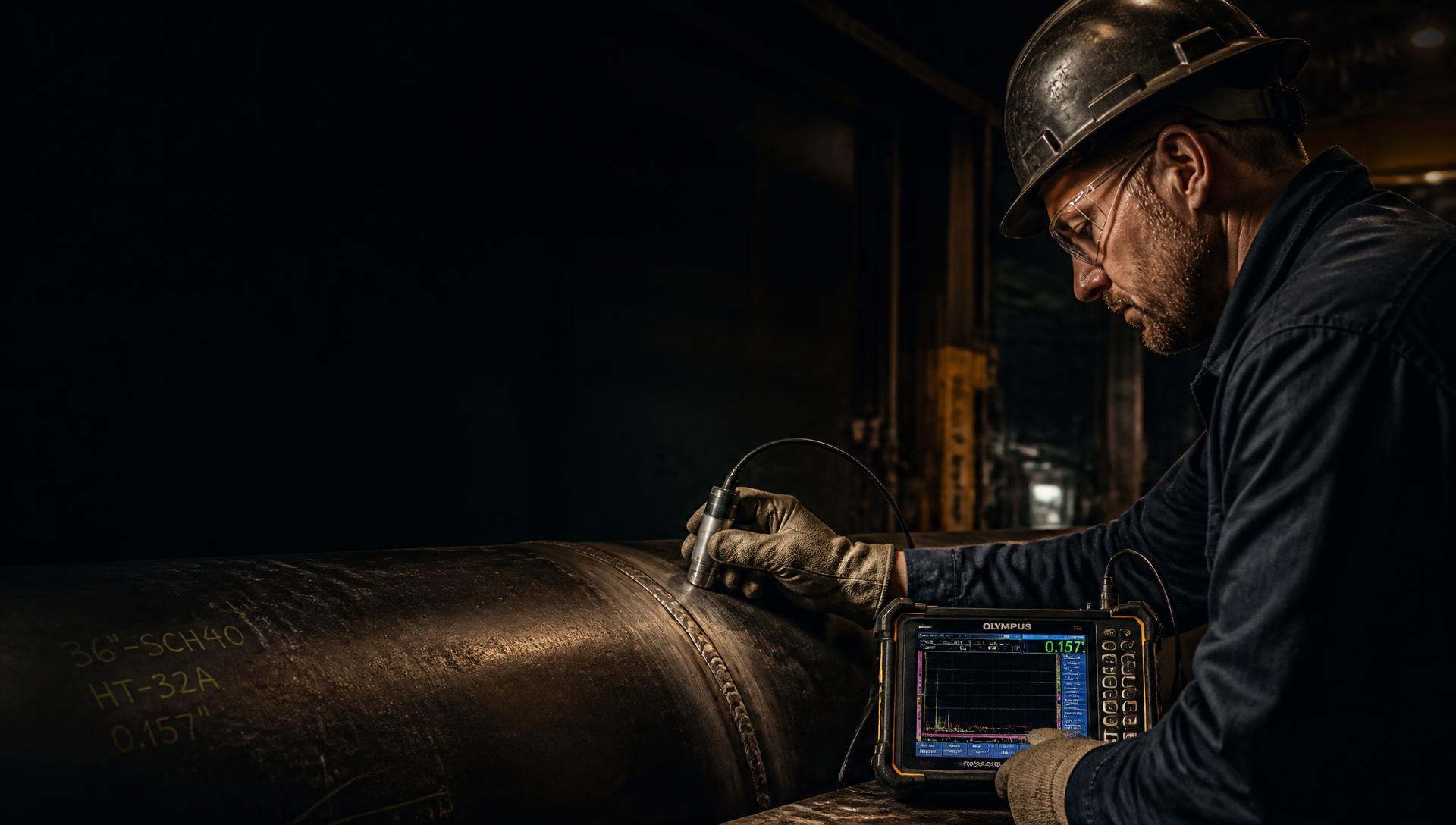
Ultrasonic testing, or UT, sends high-frequency sound waves into a material and evaluates the returning signals. It can be used to locate internal discontinuities, measure thickness, and gather information about a component's internal condition.
Advanced instruction may introduce phased-array ultrasonic testing, commonly called PAUT, or time-of-flight diffraction, known as TOFD. The equipment, procedures, and interpretation skills taught vary by program. (asnt.org)
Radiographic Testing
Radiographic testing, or RT, uses X-rays or gamma radiation to produce images that can reveal internal features and discontinuities.
Because industrial radiography may involve ionizing radiation, it carries specialized safety, training, monitoring, security, and regulatory responsibilities. Gamma-radiography activities may be regulated by the Nuclear Regulatory Commission or an Agreement State, while X-ray equipment is generally regulated by state agencies or applicable federal workplace-safety requirements. (nrc.gov)
Completing an NDT school program does not by itself authorize someone to conduct regulated industrial radiography.
Electromagnetic and Eddy Current Testing
Electromagnetic testing, or ET, uses electromagnetic fields to detect and evaluate discontinuities or material characteristics. Eddy current testing is a commonly used electromagnetic technique for electrically conductive materials.
Applications may include inspecting tubing, aircraft components, fastener holes, and other conductive parts. (NDT)
Other Methods
Depending on the school and industry focus, students may encounter additional methods such as:
- Leak testing
- Infrared or thermal testing
- Acoustic-emission testing
- Vibration analysis
- Guided-wave testing
- Laser-based inspection
- Digital radiography
- Computed radiography
- Remote visual inspection
A broad introductory course does not necessarily provide enough instruction or experience to qualify a student in every method.
What Can You Learn in an NDT Program?
A well-designed nondestructive testing program may combine classroom instruction, mathematics, materials science, written procedures, and hands-on laboratory practice.
Coursework may cover:
- NDT terminology and method selection
- Materials, metallurgy, and manufacturing processes
- Weld types and welding discontinuities
- Castings, forgings, composites, and other materials
- Blueprint and technical-drawing interpretation
- Codes, standards, specifications, and written procedures
- Equipment setup, calibration, and performance checks
- Surface preparation and inspection conditions
- Test sensitivity and variables that affect results
- Indication recognition and interpretation
- Measurement and basic technical mathematics
- Quality assurance and quality control
- Technical reporting and recordkeeping
- Workplace and radiation safety
- Professional ethics and technician responsibilities
The strongest programs should teach students not only how to operate equipment, but also how inspection variables, materials, geometry, and procedures affect the reliability of a result.
Is NDT Training a Good Fit for You?
Nondestructive testing may appeal to people who like technology, hands-on work, problem-solving, and detailed inspection.
Helpful qualities include:
- Close attention to detail
- Comfort following exact procedures
- Mechanical and technical curiosity
- Pattern recognition
- Careful documentation
- Reliable judgment
- Willingness to work in industrial environments
- Respect for safety requirements
- Clear written and verbal communication
O*NET identifies cautiousness, integrity, attention to detail, and dependability as important work styles for NDT specialists. It also reports that accuracy can be extremely important and that errors may have serious consequences. (Non-Destructive Testing Specialists)
Where Do NDT Technicians Work?
NDT is used anywhere organizations need to evaluate components without destroying them. Work settings may include:
- Aerospace manufacturing and aircraft maintenance
- Automotive and advanced manufacturing
- Energy and power generation
- Oil, gas, and pipeline operations
- Refineries and chemical facilities
- Construction and infrastructure
- Bridges and transportation systems
- Rail and shipbuilding
- Welding and fabrication
- Testing laboratories
- Government and defense operations
- Wind-energy and other renewable-energy facilities
O*NET identifies government and professional, scientific, and technical services among the leading industries for the broader occupational group. (Non-Destructive Testing Specialists)
The work environment can vary substantially. Some technicians work primarily in controlled laboratories or manufacturing facilities. Others travel to construction sites, plants, hangars, pipelines, or outdoor structures.
O*NET respondents reported work involving protective equipment, outdoor conditions, noise, awkward spaces, heights, hazardous equipment, and—in some roles—radiation. These conditions will not apply to every NDT job. (Non-Destructive Testing Specialists)
NDT Training and Certification Are Not the Same Thing
This distinction should be understood before choosing a program.
- Training is the organized instruction and laboratory practice used to learn an NDT method.
- Qualification is the combination of knowledge, skills, training, experience, examinations, and physical capabilities required for particular work.
- Certification is written documentation that a person has satisfied the requirements of a specific certification system.
Under employer-based programs following ASNT Recommended Practice No. SNT-TC-1A, the employer is responsible for its written practice and for qualifying and certifying its personnel. A school does not automatically issue an employer's certification simply because a student completes coursework. (asnt.org)
ASNT also offers central certification programs with their own eligibility, experience, and examination requirements. Students should determine which certification model is used by prospective employers and whether a school's training hours satisfy the applicable requirements. (certification.asnt.org)
Understanding NDT Levels
The responsibilities associated with Level I, Level II, and Level III personnel depend on the governing standard, employer written practice, industry, method, and applicable contract or code.
In general:
Level I
Level I personnel commonly perform specific calibrations, tests, and evaluations under written instructions and appropriate supervision. Their authority may be limited to recording results rather than independently selecting methods or determining final acceptance.
Level II
Level II personnel generally have greater responsibility for setting up and calibrating equipment, performing tests, interpreting results, and documenting findings according to applicable procedures and requirements.
ASNT's Level II certification process includes method-specific requirements. For employer-based certification, practical testing and possibly additional specific examinations may remain the employer's responsibility. (certification.asnt.org)
Level III
Level III work may involve developing or approving procedures, interpreting codes and standards, selecting appropriate methods, overseeing operations, and training or examining other personnel.
ASNT describes Level III responsibilities as including procedure development, operational management, and team training. (certification.asnt.org)
A school should clearly explain whether its curriculum provides introductory education, documented classroom hours, certification preparation, or another level of training.
How Long Does NDT Training Take?
NDT education may be offered through short method-specific courses, certificate programs, apprenticeships, employer training, or associate-degree programs.
There is no single program length that applies to every student or certification path. The time required depends on:
- The number of methods studied
- Classroom-training requirements
- Laboratory hours
- Supervised work-experience requirements
- The certification system being followed
- Previous education and experience
- Employer and industry requirements
For example, ASNT publishes different minimum training amounts for individual methods in connection with its Level II certification pathway. It also requires qualifying work experience gained under appropriate supervision. (certification.asnt.org)
Ask each school to identify its actual clock hours, laboratory hours, credential awarded, completion requirements, and relationship to recognized certification requirements.
How to Compare NDT Schools
Before choosing a program, ask:
- Which NDT methods are included?
- How many classroom and hands-on laboratory hours are provided for each method?
- Are training hours documented by method?
- Which edition of SNT-TC-1A, CP-189, ISO 9712, NAS 410, or another standard does the curriculum address?
- Does the program provide training, certification preparation, central certification, or employer-based certification?
- Who ultimately issues any certification?
- Is supervised work experience included?
- Does the school help students obtain qualifying experience after graduation?
- What inspection equipment will students use?
- Does the curriculum cover conventional and advanced digital methods?
- Are instructors currently qualified in the methods they teach?
- Which industries recruit from the program?
- Are radiation-safety courses or credentials included for radiographic testing?
- What prerequisites, vision examinations, experience, or additional exams will graduates still need?
- What is the complete cost, including equipment, examinations, certification applications, and required safety training?
- Can the school document completion, placement, and credential outcomes?
Do not rely solely on the phrase “certification training.” Ask the school to explain precisely what credential or documented training you will possess at graduation and what an employer must still verify.