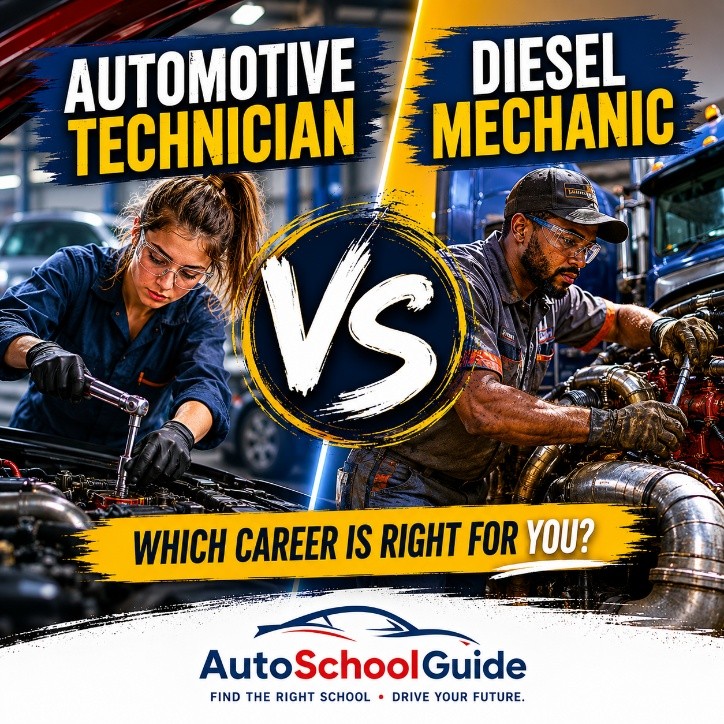
Short answer: Automotive technicians work mainly on gasoline, hybrid and electric passenger cars and light trucks, while diesel technicians work mainly on diesel-powered commercial trucks, buses, and heavy or industrial equipment. Both paths teach shared diagnostic fundamentals, so the better choice depends on the machines and work settings you prefer.
If you’re interested in working with vehicles, two popular career paths are automotive technician and diesel mechanic. Both careers involve diagnosing, repairing, and maintaining vehicles, but the type of equipment, work environment, and training can be different.
Understanding the difference can help you choose the path that fits your interests and career goals.
What Does an Automotive Technician Do?
Automotive technicians usually work on cars, SUVs, and light trucks. Their work may include:
- Oil changes
- Brake repair
- Engine diagnostics
- Electrical system repairs
- Suspension and steering work
- Air conditioning service
- Transmission-related repairs
Automotive technicians often work in dealerships, independent repair shops, tire centers, or fleet service departments.
What Does a Diesel Mechanic Do?
Diesel mechanics work on vehicles and equipment powered by diesel engines. This may include:
- Semi-trucks
- Buses
- Construction equipment
- Agricultural equipment
- Delivery trucks
- Heavy-duty fleet vehicles
Diesel work often involves larger engines, heavier parts, and more commercial or industrial settings.
Training Differences
Automotive training programs usually focus on passenger vehicles and light trucks. Students learn about gasoline engines, computerized diagnostics, brakes, steering, electrical systems, and general vehicle repair.
Diesel training programs focus on diesel engines, heavy-duty systems, hydraulics, air brakes, fuel systems, and large vehicle maintenance.
Some schools offer both automotive and diesel programs, allowing students to choose a specialty.
Work Environment
Automotive technicians commonly work in:
- Car dealerships
- Independent repair shops
- Quick-service centers
- Tire and brake shops
- Fleet maintenance facilities
Diesel mechanics may work in:
- Trucking companies
- Construction companies
- Bus garages
- Heavy equipment shops
- Government fleet departments
- Agricultural equipment dealerships
Which Career Is More Hands-On?
Both careers are hands-on, but diesel work may involve more heavy-duty equipment and physically demanding repairs. Automotive work often involves more consumer vehicles, diagnostic tools, and fast-paced shop environments.
Career Advancement
Automotive technicians can advance into roles such as:
- Master technician
- Diagnostic specialist
- Service advisor
- Shop foreman
- Service manager
- Shop owner
Diesel mechanics can advance into roles such as:
- Heavy equipment technician
- Fleet maintenance supervisor
- Diesel diagnostic specialist
- Shop lead
- Field service technician
- Fleet manager
Which Path Should You Choose?
Choose automotive technology if you like:
- Cars and light trucks
- Consumer vehicle repair
- Dealership or independent shop work
- Electrical diagnostics
- Fast-moving repair environments
Choose diesel technology if you like:
- Large engines
- Trucks and heavy equipment
- Commercial fleet work
- Industrial settings
- Heavy-duty mechanical systems
Final Thoughts
Both automotive technicians and diesel mechanics play important roles in keeping vehicles and equipment running. The best choice depends on the type of machines you want to work on and the environment where you want to build your career.
Ready to compare programs? Explore automotive and diesel mechanic schools to find the right training path.
Automotive vs. Diesel at a Glance
| Comparison | Automotive technology | Diesel technology |
|---|---|---|
| Typical equipment | Cars, SUVs, light trucks, hybrids and electric vehicles | Class 7-8 trucks, buses, construction and agricultural equipment, generators, some marine engines |
| Common employers | Franchised dealerships, independent repair shops, specialty and collision shops | Fleet maintenance operations, truck dealerships, equipment dealers, transit agencies, field service |
| Training emphasis | Engine performance, electrical and network diagnostics, brakes, steering and suspension, HVAC, increasingly high-voltage systems | Diesel engine systems, fuel and air management, emissions aftertreatment, hydraulics, air brakes, heavy electrical systems |
| Work environment | Mostly indoor shop bays; frequent, shorter repair orders | Shop bays, yards and field or roadside service; larger components and lifting equipment |
| Certification examples | ASE A-series automotive tests; manufacturer training | ASE T-series medium/heavy truck tests; a commercial driver license may be required by some employers |
Comparison reflects general occupational descriptions published by the U.S. Bureau of Labor Statistics for automotive service technicians and mechanics and for diesel service technicians and mechanics, and certification series published by ASE. Individual employers, shops and schools vary.
How Does the Training Differ?
Both programs usually begin with shared fundamentals: shop safety, hand and power tools, measuring, basic electrical theory and a structured diagnostic process. From there the coursework separates. Automotive programs spend more time on light-vehicle engine management, vehicle networks, driver-assistance components and increasingly on hybrid and high-voltage safety. Diesel programs spend more time on large-displacement diesel engines, fuel systems, emissions aftertreatment, hydraulics and air brake systems. Program length, credential type and equipment differ by school, so compare curricula directly.
What Certifications May Be Relevant?
ASE certification is voluntary and widely recognized in both fields. Automotive technicians commonly pursue the A-series tests; medium and heavy truck technicians commonly pursue the T-series. Manufacturer and equipment-maker training is separate from ASE and is usually provided through an employer. Some diesel roles, particularly mobile or road-service work, ask for a commercial driver license. Confirm requirements with the employers you want to work for.
Can You Move Between the Two Fields Later?
Yes. Diagnostic reasoning, electrical troubleshooting, hydraulics and shop practices transfer between the fields, and many technicians change lanes after gaining experience. Moving usually means learning new systems, new service information and, in some cases, new certifications rather than starting over. Neither path is universally better; each simply serves different equipment and customers.
Compare Programs and Schools
- Automotive Technology program guide
- Diesel Technology program guide
- Search automotive technology schools
- Search diesel technology schools
Source references: BLS: Automotive Service Technicians and Mechanics, BLS: Diesel Service Technicians and Mechanics, ASE certification.